
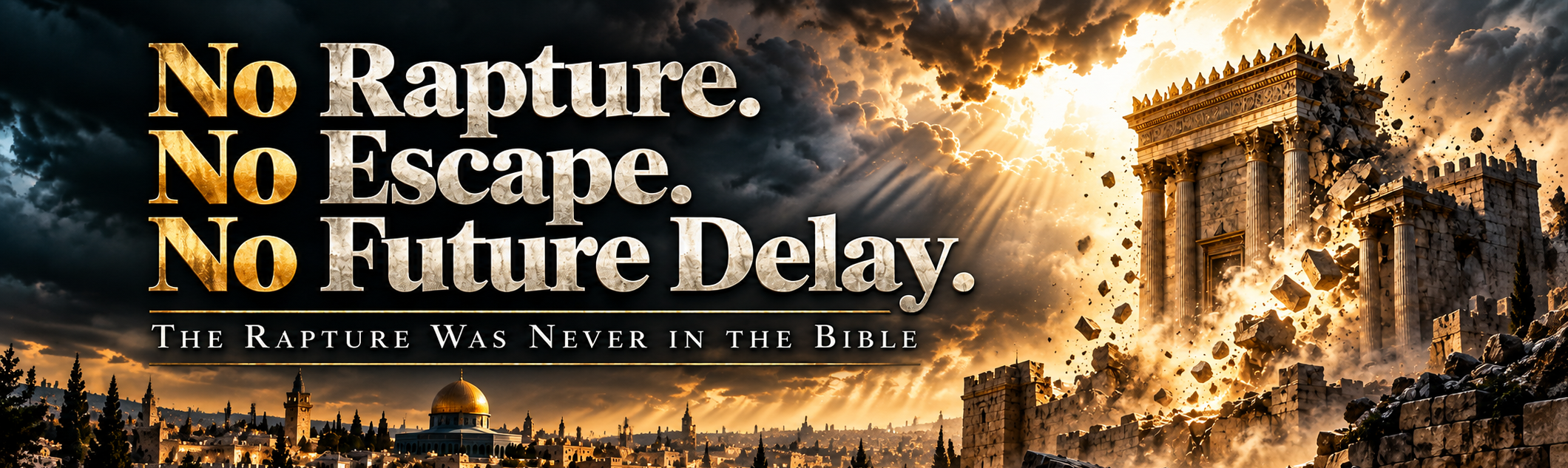
No Rapture. No Escape. No Future Delay.

The rapture is a common doctrine found throughout many Christian circles. It teaches that at some unknown moment Jesus will return partway to earth, believers will suddenly disappear, graves will open, people will be caught up into the sky, and the world will enter a period of unprecedented tribulation. After several years, Jesus will return again, this time visibly, to complete what began at the rapture.
For many of us, this was never presented as one possible interpretation of Scripture. It was simply presented as what the Bible taught. We learned the timeline before we ever learned how to read the passages that supposedly created it, so when we eventually opened those passages for ourselves, we already knew what we were expected to see. We were not really discovering the meaning of the text as much as finding pieces that fit a story we had already been given.
What is crazy to me now is that the rapture doctrine does not actually appear anywhere in Scripture as a complete teaching. There is no passage where Jesus or one of the apostles explains a future event in which believers suddenly disappear from the earth before a worldwide tribulation. There is also no passage that lays out the familiar sequence of a church age followed by a rapture, seven years of tribulation, another coming of Jesus, and then the establishment of the kingdom.
That system is created by taking language from several different passages, separating those passages from their historical and covenantal setting and language, and arranging them into a theological timeline. Once that timeline becomes fixed in our minds, words such as coming, clouds, trumpet, gathering, resurrection, wrath, and judgment automatically get slapped with a modern interpretation and pushed into our future.
So what happens if we stop doing that? What happens if we allow those words to remain where the writers placed them, within the covenantal world of the first century? Once we do that, the whole picture begins to change.
The First Question Is Not “When Is the Rapture?”
Before we examine individual passages, there is a more basic question that has to be asked: who were these words originally spoken to? That question alone begins to clear away a lot of confusion because the New Testament was not written directly to us or about our time, even though it has been preserved for us. These letters were written to specific people, living in specific circumstances, for specific reasons. They were addressing things those communities were actually experiencing, anticipating, and trying to understand. The writings themselves are filled with time statements and audience markers that continually locate what was being said within their world. If we ignore those markers and immediately assume every warning, promise, coming, judgment, or expectation is speaking about our future, we can completely change the meaning of the text.
Jesus was not speaking Matthew 24 to people living two thousand years later. He was answering His own disciples, who had just asked Him about the destruction of the temple standing directly in front of them. Paul was not writing Thessalonians to modern prophecy students. He was writing to real communities living in the middle of a massive covenantal transition from the old covenant into the new. Revelation was not addressed to a generation thousands of years after John. It was sent to seven real assemblies in Asia Minor who were already living through the unraveling of the old covenant world.
We can easily underestimate how enormous that transition was for them. The old covenant had shaped their world for more than fifteen hundred years. It influenced their understanding of God, worship, identity, priesthood, sacrifice, sacred space, community, and even the way they understood history itself. The temple was not simply a religious building sitting in Jerusalem; it stood at the center of an entire covenantal order that had defined generations. Their whole world had been formed inside that system, and now they were living through its dramatic and traumatic end while a new covenant reality was being unveiled in Christ. Their world was being uprooted.
Audience relevance changes the way we hear these passages. When Jesus tells His disciples, “When you see,” the natural assumption is that the people hearing Him could actually see what He was describing. When Paul tells a community, “You know what is restraining,” the natural assumption is that they knew what he was talking about. When Revelation repeatedly says that the time was near and that these things must shortly take place, the most natural reading is that the message concerned the world of those original hearers.
John was writing to them, about their time, and about what they were approaching. He was not secretly writing past them to us while giving them language that sounded immediate but would not actually be fulfilled for thousands of years.
If we remove the first-century audience, we can make almost any passage say almost anything. Once we restore them, the modern rapture system immediately begins to lose its footing.
1 Thessalonians 4 Is About the Dead in Christ, Not an Escape From Earth
The main passage used to support rapture theology is 1 Thessalonians 4:13–18. Paul does describe a catching up here, so there is no need to pretend that language is not in the text. The real question is what Paul means by it and what problem he is actually trying to answer.
Paul begins the section by talking about those who had died. He tells the Thessalonians that he does not want them to be uninformed concerning those who had “fallen asleep.” Their concern was not how to escape a future worldwide tribulation. Their concern was what would happen to people among them who had already died before the coming they were expecting.
Paul reassures them that those people had not missed anything. The dead in Christ would not be left out, and the living would not have some advantage over them. He describes the dead rising first and then says that those who were alive and remained would be “caught up together with them in the clouds to meet the Lord in the air.”
So yes, Paul absolutely speaks about a catching up. What he does not do is explain the modern rapture scenario that has been built around that phrase. He never says that this gathering removes believers from the earth for seven years, that Jesus takes them back to heaven, or that it happens so they can avoid a future tribulation. None of those ideas are part of the question Paul is answering.
The phrase “caught up” comes from the Greek word harpazō, which carries the idea of being seized, taken up, or caught away. That word describes the action, but it does not tell us the destination or create a complete end-times timeline. The rest of the passage has to tell us what kind of event Paul is describing.
Paul says they are caught up “to meet the Lord.” The word translated “meet” was commonly used for people going out to welcome an arriving person and then accompanying that person as he continued toward his destination. We see that pattern in Acts 28 when believers from Rome travel out to meet Paul and then return with him into the city. The same idea appears in Jesus’ parable of the virgins who go out to meet the arriving bridegroom. The language of scripture interprets itself.
Paul never says that Jesus descends, gathers everyone, reverses direction, and takes them back into heaven. He says they meet the Lord. Later theology adds the return trip to heaven and the seven-year interval.
The language of clouds also belongs to the prophetic world Paul and his readers already knew. Throughout the Hebrew Scriptures, clouds are frequently connected with the coming, authority, presence, and judgment of God. Isaiah 19 describes the Lord riding on a swift cloud and coming into Egypt, yet no one reads that as God physically traveling through the atmosphere on a literal cloud.
Daniel 7 also speaks of the Son of Man coming with the clouds of heaven. In that vision, the Son of Man is brought before the Ancient of Days and receives authority, glory, and kingdom. Cloud language was already loaded with covenantal and kingdom meaning long before Paul used it in Thessalonians. This is a language the culture was familiar with.
The trumpet language belongs to that same prophetic vocabulary. Trumpets announced gatherings, judgment, royal arrival, and major covenantal moments. Paul was not inventing a new collection of end-times symbols. He was drawing from a language his audience already understood. This is what we call conventional language.
Once the passage is allowed to remain in its own setting, its focus becomes much clearer. Paul is comforting grieving people and assuring them that those who had died would fully participate in the coming and gathering they were expecting. He does speak about a catching up, but he never turns that catching up into an evacuation of believers from the earth before a future tribulation.
The modern rapture doctrine takes one phrase from this passage and builds an entire timeline around it. Paul himself never does that.
The “Coming of the Lord” Was Not Automatically the End of Planet Earth
One of the biggest assumptions behind rapture theology is that whenever the New Testament speaks about the coming of the Lord, it must refer to a physical return of Jesus at the end of human history. But Scripture had been using coming language long before the New Testament.
All throughout scripture, God “came” against nations in judgment. He “came” in clouds, in fire, and through invading armies and historical events. The language described the manifestation of His authority within history, and Scripture itself gives us the vocabulary for understanding later passages.
That becomes especially clear when we come to Matthew 24. Jesus and His disciples were standing at the temple, and the disciples were admiring the buildings of that temple. Jesus responded by telling them that not one stone of that temple would be left upon another, which naturally led them to ask when those things would happen and what sign would accompany His coming and the end of the age.
The subject and context is already established before Jesus begins answering. They are talking about the temple, Jerusalem, and the end of the old covenant age they were living in. That is the context of the conversation.
Jesus then speaks directly to them. He tells them that they will hear of wars, that they will be persecuted, and that they will see signs connected with Jerusalem’s coming destruction. He tells those in Judea to flee to the mountains, speaks about people standing on rooftops, and even mentions Sabbath travel. Everything about the language fits their world, not ours.
Then He gives the statement that should govern the whole passage: “THIS GENERATION will not pass away until all these things take place.”
The rapture framework has had to work extremely hard to move that statement away from the people Jesus was actually talking to. The simplest reading is the clearest one. Jesus was describing the end of their old covenant age and the coming judgment upon Jerusalem, the temple, and the system of governance built around it.
That judgment came in AD 70 when the temple was destroyed and the old covenant world centered around sacrifice, priesthood, sacred space, and Jerusalem collapsed. It happened in the generation Jesus said it would happen in and it happened just as he said it would.
Jesus was not warning us about a future end of the planet. He was warning them about the end of the world they knew.
“One Taken and One Left” Is Not the Rapture
Matthew 24 contains another passage frequently used to support the rapture. Jesus says that two will be in a field, one will be taken and the other left, and two women will be grinding, one will be taken and the other left.
Popular rapture imagery has trained us to picture one person suddenly disappearing into heaven. But Jesus had just compared what was coming to the days of Noah, and that comparison points in a very different direction.
In Noah’s story, the ones who were taken away were the ones who came under judgment. Noah and his household were the ones who remained. That does not fit the common rapture picture where the righteous disappear and the others are left behind.
Luke makes the traditional reading even harder to sustain. In Luke 17, Jesus again speaks about one being taken and another being left, and the disciples ask, “Where, Lord?” In other words, where are these people being taken?
Jesus answers by speaking about the body and the gathering of vultures or eagles. Whatever else we may see in that imagery, it is clearly not the language of believers being safely transported to heaven. It is the language of death, judgment, and a system reaching its end.
That fits the larger warning Jesus had already given His followers. When they saw the signs He described, they were not told to wait for a supernatural rapture evacuation. They were told to flee. Those who heard His warning were to leave Jerusalem and separate themselves from the city and the covenantal system that was about to collapse.
That gives the language of “one taken and one left” a very different feel. Some would recognize what was happening and get out, while others would remain attached to the temple, the city, and the old covenant order they believed could never fall. The issue was not who would disappear into heaven. The issue was who would heed Jesus’ warning and who would remain devoted to a world that was already passing away.
So when the disciples ask, “Where, Lord?” and Jesus answers with the image of vultures or eagles gathering around a body, the picture points toward the place of judgment. The dead body represents something whose life is over, and the birds gather where that death has become visible. Jerusalem and the old covenant system had reached that point. Jesus was warning His followers not to remain bound to what was about to come down.
Once the Noah comparison, the first-century setting, and the disciples’ own question are allowed to remain in place, the passage stops looking like rapture theology.
John 14 Is About Dwelling, Not Evacuation
Another familiar passage says, “In My Father’s house are many dwelling places,” and, “I go to prepare a place for you.” Many of us were taught to imagine Jesus going into heaven to build rooms or mansions so He could eventually return and take believers there.
But the rest of John 14 moves in a very different direction. The chapter is saturated with union and indwelling.
Jesus says, “I am in My Father, and you in Me, and I in you.” He tells the disciples that He will not leave them as orphans and that He will come to them. He also says the Father and Son will make their home with them.
The same family of language used for the dwelling places in the Father’s house appears again when Jesus speaks of making His dwelling with humanity. The movement of the chapter is not humanity abandoning earth to live somewhere else with God. The movement is toward the revelation of shared dwelling and union.
Jesus is preparing them for the collapse of the old temple-centered imagination in which God was thought to dwell in a sacred building while humanity remained outside. The true dwelling of God was being revealed in Christ and then in humanity joined with Him.
That is very different from rapture theology. The rapture says the goal is humanity leaving earth to go where God is, while union reveals that the entire framework of distance and separation has come to an end. Union does not point us toward escaping earth to reach Christ somewhere else; it reveals Christ in you, here and now, with humanity becoming the visible expression of the Life within.
1 Corinthians 15 Is About the Transition From Adam to Christ
First Corinthians 15 is often combined with 1 Thessalonians 4 because Paul says, “We shall all be changed,” and speaks about the last trumpet. Once again, the rapture system hears that language and immediately places it at the end of human history, as though Paul is describing a future moment when physical bodies are suddenly transformed and believers leave the earth.
But if we slow down and follow Paul’s argument through the chapter, that is not the story he is telling. His entire discussion is built around Adam and Christ, death and Life, corruption and incorruption, natural and spiritual, and the transition from one order of humanity into another.
When Paul speaks about death, we have to ask what kind of death entered through Adam. Adam did not physically drop dead the day he ate from the tree, even though God had said, “In that day that you eat of it you shall surely die.” Whatever happened in Adam was deeper than the immediate cessation of physical life. Humanity entered a condition of death, alienation, corruption, condemnation, and separation-consciousness.
That is the death Paul keeps connecting to Adam. He says, “In Adam all die,” and then contrasts that with, “In Christ all shall be made alive.” His concern is not simply that Adam caused human bodies to stop functioning biologically and Jesus will one day reverse that process. That is not at all what he is communicating. Paul is contrasting two humanities, two identities, and two covenantal orders. One is rooted in Adam. The other is rooted in Christ.
Paul makes that contrast over and over again throughout the chapter. He speaks of what is sown in corruption and raised in incorruption, sown in dishonor and raised in glory, sown in weakness and raised in power, and sown a natural body and raised a spiritual body. The pattern is consistent. Something belongs to one order and comes forth in another. This was the conventional transition they were experiencing from the old to the new.
That language is often read as though Paul is describing the burial and future rising of individual corpses, but the chapter itself keeps widening the conversation beyond that. Paul is speaking about the movement from the natural to the spiritual, from Adam to Christ, from corruption to incorruption, and from death into Life.
The words “natural body” and “spiritual body” are especially important. Paul is not contrasting a physical body with a nonphysical body. A “spiritual body” is still a body. His contrast is between what belongs to the Adamic order and what belongs to the Spirit, between the old humanity and the new humanity revealed in Christ.
That becomes even clearer when Paul says, “The first man Adam became a living being. The last Adam became a life-giving Spirit.” He then says, “The first man was of the earth, made of dust; the second Man is the Lord from heaven.” Paul is tracing two identities. One is the old humanity shaped by Adam; the other is the new humanity revealed in Christ.
He even says, “As we have borne the image of the man of dust, we shall also bear the image of the heavenly Man.” That is not merely about a future change in the material composition of the human body. It is about the unveiling of a new identity and a new mode of existence.
This also helps explain Paul’s statement that “flesh and blood cannot inherit the kingdom of God.” If Paul meant that physical human bodies cannot participate in the kingdom, then he would create a contradiction with the embodied life of Jesus and with the present reality of the kingdom itself. “Flesh and blood” is language for humanity in its natural, Adamic condition. That order cannot inherit the kingdom because the kingdom belongs to the new creation reality revealed in Christ.
The same is true of Paul’s language about corruption and incorruption. He is not simply saying that one day human biology will stop aging. He is speaking about the passing away of an order subject to death and the emergence of an order characterized by Life.
This is why the Adam-to-Christ framework is so important. Paul is describing a transition. The old humanity is giving way to the new. The natural gives way to the spiritual. Corruption gives way to incorruption. Death gives way to Life.
The resurrection language belongs inside that transition.
When Paul says, “The dead will be raised incorruptible, and we shall be changed,” he is not suddenly abandoning everything he has been saying and introducing a completely different subject about corpses coming out of graves thousands of years later. He is bringing the whole Adam-to-Christ argument to its climax.
The death being defeated is the death associated with Adam, and the Life being revealed is the Life found in Christ.
Paul even tells us what victory looks like when he says, “Death is swallowed up in victory,” and then asks, “O Death, where is your sting?” Immediately after that, he connects the sting of death to sin and the strength of sin to the law. This is absolutely huge!
If Paul were only talking about biological death, why would he suddenly connect death with sin and then connect sin with the law? His own explanation places the discussion inside the covenantal world of Adam, sin, law, and Christ.
The law belonged to the old order. Sin drew its strength from that law, and death operated through that entire system. Christ brought that world to its end and revealed a new humanity no longer defined by Adam, condemnation, or separation.
So when Paul speaks about resurrection, he is not teaching people to wait thousands of years for God to finally solve the problem of death. He is describing the transition out of the old creation order into the new creation reality revealed in Christ.
The repeated pattern of the chapter keeps saying the same thing in different ways: natural gives way to spiritual, corruption gives way to incorruption, Adam gives way to Christ, death gives way to Life.
That is the resurrection story Paul is telling!
It is not an escape plan, and it is not a promise that humanity must wait until the end of history before resurrection Life becomes real. It is the announcement that the old Adamic order has been brought to its end and that Life in Christ is the reality of the new creation.
The “Last Trumpet” Belongs to the Same Covenant Story
Both 1 Thessalonians 4 and 1 Corinthians 15 speak about trumpets, and Matthew 24 also speaks about a great trumpet and the gathering of the elect. These passages are usually separated and placed at different points in a future prophetic timeline, but the language itself keeps drawing them together.
Jesus speaks about the Son of Man coming, clouds, angels, a trumpet, and gathering. Paul speaks about the coming of the Lord, clouds, a trumpet, and gathering. First Corinthians speaks about resurrection transformation at the last trumpet.
There is no obvious reason to assume these passages are describing unrelated events separated by thousands of years. It makes far more sense to hear them as different expressions of the same covenantal transition.
Jesus announced the end of the old covenant age, and Paul lived in the final years of that transition. His language reflects the same expectation, which is why he speaks with such immediacy.
He says, “We who are alive and remain.” He tells the Thessalonians that the mystery of lawlessness was already at work and reminds them that they knew what was restraining. He speaks as someone addressing people who were already living inside the events he was describing.
Those statements only become confusing when we insist Paul was primarily talking about us.
Revelation Never Teaches a Rapture
Revelation is often treated as the book that completes the rapture system, but Revelation never actually describes the church disappearing before a future tribulation. Instead, that idea is brought into the book and then read back into certain passages.
Some point to Revelation 3:10, where Jesus tells the church in Philadelphia that He will keep them from the hour of trial. But Jesus is speaking to a real first-century community, not directly to people living thousands of years later.
The phrase “keep from” also does not require physical removal. In John 17, Jesus prays that His disciples wouldNOT BE TAKEN OUT OF THIS WORLD but would be kept from evil. The language can describe preservation without evacuation.
Others point to Revelation 4:1, where John hears, “Come up here.” It is sometimes taught that John’s movement into a heavenly vision symbolizes the rapture of the church, but the text never says that. John is told to come up because he is receiving a vision. Turning him into a symbol for a future disappearing church is not something coming from the passage itself. It is theology being inserted into the text.
Revelation repeatedly emphasizes that its events were near, that the time was at hand, and that these things would shortly take place, in their generation. That context should not be ignored or explained away simply because it does not fit a modern prophetic timeline.
The book is saturated with the collapse of the old covenant world, the exposure of a violent system, the destruction of the harlot city, the end of a persecuting order, and the unveiling of new creation. It is not a roadmap for believers waiting to leave earth.
2 Thessalonians 2 Does Not Give Us a Future Rapture Timeline
Second Thessalonians 2 is one of the passages frequently used to defend rapture theology, especially because Paul opens the chapter by speaking about “the coming of our Lord Jesus Christ and our gathering together to Him.” Those words sound familiar because they connect directly with the language of 1 Thessalonians 4, where Paul speaks about believers being gathered to meet the Lord.
But before we build a future timeline around those words, we need to slow down and notice what Paul is actually doing. He is writing to the same community he had already spoken to about the coming of the Lord, the gathering, the trumpet, the dead in Christ, and those who were alive and remained. Second Thessalonians is not introducing a completely different prophetic system. Paul is continuing the same conversation.
He begins by saying, “Now, brethren, concerning the coming of our Lord Jesus Christ and our gathering together to Him.” Paul places the coming and the gathering together in the same sentence and treats them as part of the same expectation. He does not explain one coming in which believers are taken away and then another coming years later when Jesus returns again. That distinction comes from the later system, not from Paul’s wording.
In rapture theology, the gathering is often separated from the coming. The gathering becomes the rapture, while the coming becomes a later visible return. But Paul does not divide them that way. He speaks about the coming of Jesus and the gathering of the people together around that coming.
The chapter becomes even more interesting when we look at why Paul is writing. The Thessalonians were apparently being shaken by claims that the day of the Lord had already arrived. Paul tells them not to be troubled as though that day were already present, and then he reminds them of things that had to unfold.
That tells us something immediately. These people believed the events Paul had previously described were close enough that they could actually be deceived into thinking they had already begun. If Paul were really talking about an event thousands of years in their future, their confusion would make very little sense.
Paul then speaks about a falling away, a man of lawlessness, opposition, the temple, and something restraining what was unfolding. These verses have been turned into one of the most complicated parts of modern prophecy teaching, with endless attempts to identify a future Antichrist, a future rebuilt temple, and a future political system. But Paul himself talks as though the Thessalonians already knew what he meant.
He says, “Do you not remember that when I was still with you I told you these things?” Then he says, “And now you know what is restraining.”
That is easy to read past, but it should completely shape the way we approach the passage. Paul is not introducing mysterious details that would only make sense to people living two thousand years later. He had already explained these things to them in person, and he expected them to recognize what he was talking about.
Whatever the restraining power was, they knew it and whatever situation Paul was describing, they had already been taught about it. Whatever lawlessness he had in mind, it belonged to their world closely enough for him to say, “The mystery of lawlessness is already at work.” That phrase is one of the clearest time markers in the chapter.
Paul does not say the mystery of lawlessness will begin working in a distant generation. He says it was already at work while he was writing. That places the passage inside their historical and covenantal moment.
The same is true of the man of lawlessness. Even if people disagree over the exact historical identity Paul had in mind, we do not need to force every detail into a future prophecy chart. Paul’s own language tells us that the forces connected with that figure and that system were already operating in the first century.
The temple language also has to be heard in that setting. Paul was writing during a time when the temple in Jerusalem was still standing. There is no need to immediately imagine a rebuilt temple thousands of years later when the temple connected with their covenantal world was still physically present and approaching destruction.
This fits the larger New Testament story. Jesus had already announced the fall of the temple and the end of the old covenant age. Paul was living in the final years of that transition. The law, the priesthood, the sacrifices, Jerusalem, and the temple still existed and were still functioning, but their covenantal authority had already been brought to its end in Christ. The old world was still standing outwardly while the new had already been revealed.
That tension explains much of the urgency in the New Testament. The writers were living between accomplishment and historical manifestation. Christ had completed the work, but the old covenant structure had not yet visibly collapsed. That collapse came in AD 70 when Jerusalem and the temple were destroyed.
Second Thessalonians 2 belongs inside that transition. Paul is helping the Thessalonians understand events surrounding the end of the age they were living in. He is not giving twenty-first-century readers a coded sequence for a future rapture, future Antichrist, future rebuilt temple, and future seven-year tribulation.
There is also a phrase later in the chapter that is often overlooked. Paul says the lawless one would be destroyed “with the breath of His mouth” and brought to nothing “by the appearance of His coming.”
That language belongs to the prophetic world of Scripture. The coming of the Lord is associated with the exposure and collapse of what stood against the new covenant reality, and Paul is describing the removal of an order that could not remain once Christ had been fully revealed. This is the same framework we see in the Gospels, where Jesus repeatedly placed the coming of the Son of Man within the generation of His own hearers. He told them that some standing there would not taste death until they saw the Son of Man coming in His kingdom, and He told the high priest that he would see the Son of Man coming on the clouds of heaven. Those statements only make sense if the coming Jesus spoke about was something that would be revealed within their world and within their generation, not an event postponed for thousands of years.
The chapter is about transition, exposure, and the collapse of a world already passing away.
When this passage is removed from its first-century setting, it becomes an almost endless puzzle. We start looking for a future Antichrist, a future temple, a future restrainer, and a future generation that will finally experience what Paul described.
But when we put the Thessalonians back into the passage, the language begins to make sense. They were not spectators reading about someone else’s future. They were participants living through the final years of the old covenant age.
Paul was telling them how to understand what was happening around them.
And once again, nothing in the chapter gives us the familiar rapture timeline. Paul does not describe believers disappearing before seven years of tribulation and then returning with Jesus later. He speaks about the coming of the Lord and the gathering together of His people as part of the same first-century covenantal expectation.
The rapture system separates what Paul keeps together and pushes into our future what Paul placed inside their world.
The Larger Problem With Rapture Theology
The deeper problem with the rapture is not simply that a few verses have been misunderstood. The doctrine changes the direction of the entire story and teaches people to look away from present Life toward a future escape.
When people are constantly told that the real hope is to leave, it becomes easy to see the earth as temporary, the body as disposable, culture as doomed, and history as something God will eventually abandon. A spirituality of departure begins to form, even if no one intentionally sets out to create it. But Jesus did not reveal a Father whose goal was to rescue humanity out of creation. He revealed Life filling humanity, dwelling in humanity, reconciling all things, and bringing new creation into visible expression. He spoke of inheriting the earth instead of escaping it. The story was never about God getting us out of here. It was about the end of separation.
The old covenant world was built around distance. There were temple courts, veils, priesthood, sacrifice, sacred spaces, restricted access, and a constant reminder that humanity stood outside. Jesus brought that order to its end, and the destruction of the temple became the visible collapse of a world built around separation.
The age ended, the temple fell, the old covenant order passed away, and the kingdom was not postponed. Union was not postponed, resurrection Life was not postponed, the coming of the Son of Man was not postponed, and judgment upon that old world was not postponed.
None of those things are hanging over our future waiting to be completed.
We Were Taught to Wait for What Scripture Says Was Fulfilled
One of the most damaging effects of rapture theology is that it keeps placing fulfillment in the future. It trains people to believe that Jesus will come, the kingdom will come, death will finally be defeated, humanity will finally be gathered, creation will finally become new, and God will finally dwell with humanity.
But the New Testament repeatedly announces these realities as the accomplishment of Christ and the reality of the new covenant. The kingdom came, the old age ended, new creation arrived, the dwelling of God is with humanity, and the separation order collapsed.
The gathering took place within the covenantal transition as Jew and Gentile, those who were near and those who were far, were brought into one new humanity. Resurrection Life became the Life of the body of Christ rather than a future promise waiting for a distant generation.
When all of these things are pushed into our future, we end up living as though the story is still unfinished. We keep waiting for God to complete something that the New Testament announces as accomplished. But once we stop reading Scripture through the rapture timeline, a very different picture comes into focus. We are not waiting to be taken somewhere else, and we are not waiting for Jesus to finish a covenantal work He left incomplete. We are learning what it means to live from what has already been accomplished.
The rapture taught us to watch the sky for an escape, while Jesus revealed Life within humanity. It taught us to prepare to leave, while the gospel announces the end of the old world of separation. It taught us to wait for God to finish something, while the finished work announces that reconciliation, union, kingdom, and Life are already ours.
The invitation is not to escape the world. It is to awaken to the Life that is already here and allow that Life to become visible through us.
Get The Book!

Rethinking the End Times
re-examine everything you thought you knew about Bible prophecy, the great tribulation, and the last days. With clarity, scriptural depth, and historical insight, this book unpacks the truth that many of these events were not predictions for our future, but fulfilled realities of the past.
Available On Amazon:
Continue The Journey
If this essay resonated with you, don't let the conversation end here. Urban Eden is more than a collection of articles—it's an ongoing journey of exploring identity, seeing God more clearly, and engaging life more fully.
Explore more reflections that challenge assumptions and invite deeper thinking.
Continue the conversation through honest discussions and fresh perspectives.
Go beyond the essays with books that unpack these ideas in greater depth.
Join us Friday evenings or discover more about our community.
Meet Serge
Serge is an author, minister, podcast host, and the founder of Urban Eden Community. his passion is helping people see God more clearly, awaken to who they are, and engage life more fully. Through essays, conversations, books, and community, his hope is to create spaces where people can ask honest questions and discover the life that's already present within them.
Stay Connected
Join others who are exploring these conversations each week.


Comments